Natural Language Interfaces for Business Functions
How an AI-assisted natural language interface can simplify ERP workflows, reduce data-entry errors, and improve productivity, with a working project management demo.
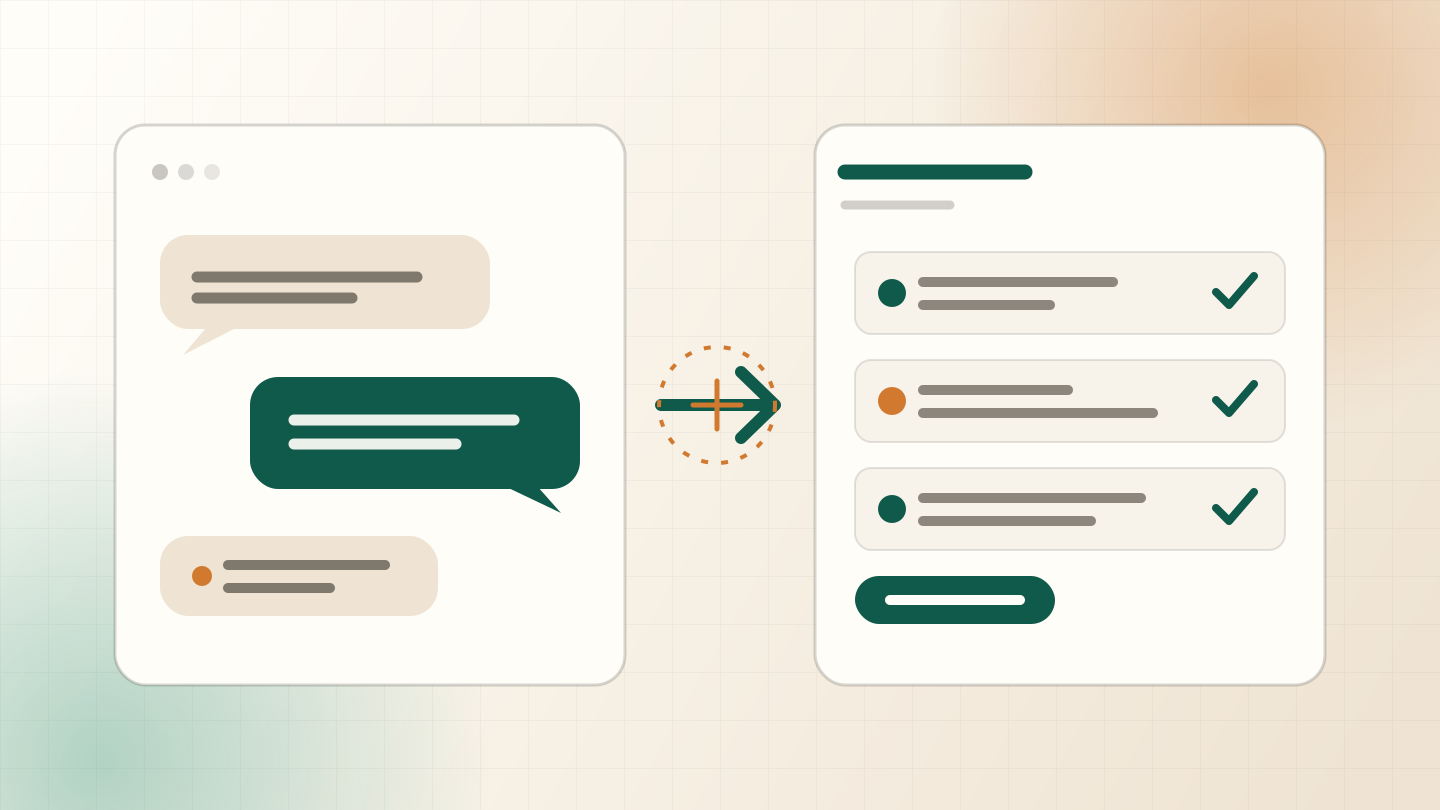
Natural language interfaces for business functions have been a goal since the early days of computing. Recent advances in AI have made this capability economically practical for many workloads and organizations. Lower-cost AI models, such as GPT-5.4 Mini, can support many natural language processing tasks and languages, although organizations should evaluate model accuracy, language quality, security, and compliance for each use case. This article provides an example of how a natural language interface can improve input accuracy and employee productivity while helping enforce business rules. It also includes a functioning demonstration focused on project management.
As business software suites, such as enterprise resource planning (ERP) systems, have become more powerful, they have also become more complicated. New features bring added complexity, increasing the knowledge required to use the systems correctly. An AI-assisted natural language interface can reduce much of this complexity. It can collect and structure user input, while deterministic application logic validates that input against business rules before processing it. The application can then use the application programming interfaces (APIs) provided by many modern software suites to perform authorized transactions.
This article focuses on ERP systems, but the approach can be extended to other software suites that provide suitable APIs. The scenario is based on my personal experience. I am intentionally leaving the specific application suite unnamed because modern business software suites share many common capabilities and implementation challenges.
The scenario: A company has a business function that records sales calls, uses AI-enabled speech recognition to transcribe them, and sends each transcript, along with an AI-generated summary, to the customer relationship management (CRM) module of its ERP system. The function supports calls in multiple languages and translates the resulting content into English. It applies only to sales personnel. In a production environment, the company would also need to comply with applicable requirements for recording consent, privacy, data retention, and access to customer communications.
The problem: To distinguish sales personnel from other employees, the ERP system provides an “Is Sales” checkbox in its web interface. HR is responsible for ensuring that employee records are correct. Because the company does not hire new employees frequently, this requirement is sometimes missed when a person joins the sales team. As a result, the CRM function does not record that employee’s calls. This omission generates a support ticket involving both HR and IT. Resolving the issue costs the business time and reduces the productivity of sales, HR, and IT personnel.
The solution: Create an AI-assisted natural language interface that collects information from the user, validates it, updates the ERP system through its API, and displays the resulting record in an information panel. A common responsive layout places the chat interface and information panel side by side on larger screens and stacks them vertically on smaller screens.
The chat interface accepts simple commands, such as “create new employee,” and prompts the user for the required information. It can also accept more detailed commands, such as “create new employee Janice Smith, date of birth 1998-08-01, mobile +15551112222, email janice.smith@gmail.com.” The AI agent prompts the user when information is missing or incomplete and requests clarification when information is ambiguous. After collecting the required information, it asks whether the user wants to provide any optional information. The agent maintains workflow context, so commands such as “list required,” “list optional,” and “show collected” return responses relevant to the current workflow.
In production use, the application enforces required fields, data types, authorization rules, and other business controls. Users are given an opportunity to review and confirm consequential changes before submission. Transactions are be logged for audit purposes.
The demo below operates in a sandbox that deletes all submitted data after one hour. It is a focused project management tool configured to decline requests outside its intended functionality.
Architecture: The web interface, API service, and database service all run on the same virtual machine under the prototype domain menacelabs.com. The web interface and API service are written in Rust, and the database is PostgreSQL. The application uses a gpt-5.4-mini model deployment in a Microsoft Foundry project. The project also contains an Agent.md file that defines the application’s general AI behavior and a Skills.md file that defines the project management workflow. These filenames describe this application’s configuration and should not be interpreted as universal Microsoft Foundry requirements.
The web interface collects information from the user and invokes a Rust method that calls the API to update the database. Publicly accessible services are placed behind a reverse proxy, while most API endpoints are bound to the local loopback interface and are not directly accessible over the public network.
Security: The demo is publicly available. In a production environment, the web interface would use an identity and access management service, such as Microsoft Entra ID or the self-hosted Keycloak platform. These platforms support standards such as OAuth 2.0 and OpenID Connect, as well as multifactor authentication (MFA), role-based access control, and other security controls.
Database updates are available only through API endpoints that are not exposed directly to the public network and that require an API key. In production, an API key is used together with network restrictions, encrypted communications, least-privilege authorization, logging, and key rotation. The API connects to PostgreSQL through a Unix-domain socket whose operating-system permissions restrict access to the appropriate no-login Linux service account. The services are managed by systemd, which can provide credentials to services without embedding secrets in application code. API keys can be rotated by updating the credential files and restarting the affected services, and this rotation process can be automated.
Costs: My company, FCSS (fcss.com.br), would charge approximately $5,000 to implement a focused workflow similar to the demo. The web interface, API service, and database run on a single, modest Azure virtual machine estimated to cost approximately $100 per month. The actual infrastructure cost would depend on the virtual machine size, region, storage, backup, networking, monitoring, availability requirements, and applicable taxes or discounts.
At the September 2026 Global Standard rates used for this estimate, GPT-5.4 Mini costs $0.75 per million input tokens and $4.50 per million output tokens. Assuming that each request uses 2,000 input tokens and 500 output tokens, 10,000 requests would cost approximately $37.50. Actual model costs depend on prompt length, response length, reasoning-token usage, caching, deployment type, and pricing changes.
Using the stated assumptions, the three-year cost would be approximately $9,950: $5,000 for implementation, $3,600 for the virtual machine, and $1,350 for model usage. This estimate excludes other potential operating expenses, such as administration, support, backups, monitoring, and additional Azure services.
Assuming a fully burdened labor cost of $20 per hour for HR, IT, and sales support personnel, the company would need to save approximately 14 staff hours per month to recover $9,950 over three years. In the scenario described in this article, one incident might consume one hour of HR time, one hour of IT time, and three hours of sales time. Under those assumptions, preventing approximately three incidents per month would produce a positive return on investment over the three-year period. More complex or frequently used workflows may produce greater productivity gains, but the expected benefits should be measured against actual implementation and operating costs.
Personal notes: I have worked in the technology field for 30 years. Throughout my career, I heard that AI was just around the corner and would change computing forever. I was skeptical of many AI-related claims. I can now say unequivocally that practical AI has arrived and is changing how software is used.
Natural language interfaces can reduce the time employees spend learning specific workflows, although they do not eliminate the need for training, governance, or well-designed business processes. At a cost that is reasonable for many organizations, such an interface can hide some of the complexity of an underlying information system. The interface can remain relatively stable while integrations and business rules are adjusted to meet changing business needs.
APIs and AI-assisted interfaces can also reduce some forms of vendor lock-in by making integrations and workflow migration easier. They do not eliminate vendor lock-in, however, because products differ in their data models, API coverage, licensing, proprietary features, and migration costs. Platforms such as Salesforce and ServiceNow expose many administrative and business functions through APIs, and AI-enabled applications can use those APIs where the required operations are supported.
The demo is implemented using Microsoft Azure services. Microsoft Foundry provides access to multiple model families, including frontier models, while Azure provides the supporting compute, networking, storage, security, and monitoring services needed to build a complete application. Models sold by Azure can be billed through an Azure subscription. I can support cloud architectures on multiple platforms, but Azure is my preferred provider for this type of workload. Organizations should select a provider based on their technical, regulatory, operational, and commercial requirements.
I am not affiliated with Microsoft or any of its associated companies.